

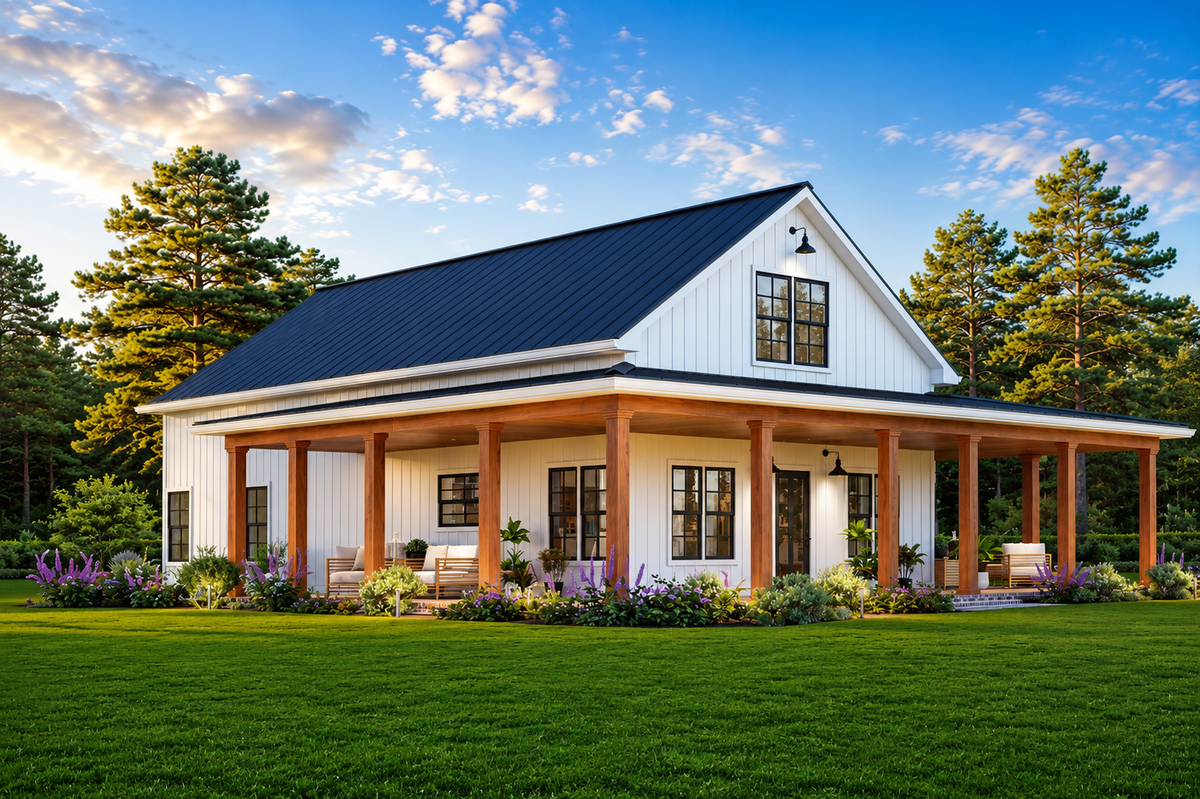
Barndominium vs. Manufactured Home: Which Is Better?
If you are looking for a more affordable way to build or buy a home, you may be comparing a barndominium vs. manufactured home. Both options can appeal to buyers who want something different from a traditional stick-built house, but they are not the same kind of home.
A manufactured home is usually built in a factory, transported to the property, and installed on-site. A barndominium is typically built as a residential home on-site using a floor plan, foundation, builder, and construction method such as steel framing, post-frame construction, a metal building system, or conventional wood framing.
Both can provide housing. Both can be more affordable than some traditional custom homes. But they differ in construction, financing, customization, durability, land requirements, resale value, storage options, and long-term flexibility.
The right choice depends on your budget, land, timeline, financing, lifestyle, storage needs, and long-term goals. If you want the fastest path to a finished home, a manufactured home may be attractive. If you want a custom residential home with more design flexibility, garage space, shop space, durability, and long-term appeal, a barndominium may be the better fit.
If you are still comparing layouts, start by browsing all barndominium plans so you can see how different bedroom counts, garages, porches, shops, and home sizes compare before making a final decision.
What Is a Barndominium?
A barndominium is a residential home inspired by barn-style architecture. Modern barndominiums are not just barns with living space added inside. They can be designed as full custom homes with open floor plans, vaulted ceilings, large kitchens, walk-in pantries, private primary suites, covered porches, garages, shops, RV bays, and high-end finishes.
Barndominiums can be built using several construction methods, including:
- Steel frame construction
- Post-frame construction
- Metal building systems
- Conventional wood framing
- Hybrid framing methods
This flexibility is one of the biggest reasons barndominiums are popular. The home can be designed around your land, driveway, views, storage needs, garage space, shop space, porch placement, family size, and long-term goals.
What Is a Manufactured Home?
A manufactured home is a factory-built home constructed in sections and transported to the site. Manufactured homes are built to federal manufactured housing standards and are usually installed on a prepared site, foundation system, or pad depending on the home, location, and financing requirements.
Manufactured homes can be single-section or multi-section homes. They may be placed on privately owned land, leased land, or inside manufactured home communities depending on local rules and property restrictions.
Manufactured homes can be a practical option for buyers who need housing quickly or want a more affordable upfront price. However, they may come with limitations related to customization, financing, land use, resale value, foundation type, and long-term durability depending on the home and location.
Barndominium vs. Manufactured Home: The Main Difference
The biggest difference between a barndominium and a manufactured home is how they are built and how much control you have over the final design.
A manufactured home is built in a factory from a model offered by the manufacturer. You may be able to choose certain finishes, layouts, and upgrades, but the home is still limited by the manufacturer’s available designs and production process.
A barndominium is usually built on-site as a residential structure. It can be based on a stock plan, modified plan, or custom design. That means you can plan the home around your land, garage, shop, porch, bedroom count, storage needs, views, and lifestyle.
In simple terms:
- Manufactured home: usually faster and more standardized.
- Barndominium: usually more customizable and more permanent-home focused.
Which Costs Less Upfront?
In many cases, a manufactured home may cost less upfront than a finished barndominium. Factory construction can make pricing more predictable and can reduce some labor costs compared to a custom on-site build.
That is one of the main reasons manufactured homes appeal to buyers who need a lower initial purchase price or a faster housing solution.
However, upfront price is not the only number that matters. When comparing a manufactured home to a barndominium, you need to look at the full project cost.
Full project costs may include:
- Land purchase
- Site preparation
- Driveway
- Foundation or pad
- Home delivery or material delivery
- Utility connections
- Septic or sewer
- Well or public water
- Permits and inspections
- Garage, shop, or storage buildings
- Porches, decks, or outdoor living spaces
- Long-term maintenance
A manufactured home may win on initial price. A barndominium may win on customization, durability, storage, garage space, land use, and long-term flexibility.
Barndominium Shell Cost vs. Finished Home Cost
Barndominium pricing can be confusing because people often talk about kit cost, shell cost, dry-in cost, and finished home cost as if they are the same thing. They are not.
A barndominium kit or shell may include framing, roofing, siding, trim, fasteners, and sometimes windows or exterior doors depending on the package. A finished barndominium includes everything required to live in the home.
A finished barndominium may include:
- Foundation
- Framing or kit package
- Roofing and siding
- Windows and exterior doors
- Insulation
- Electrical
- Plumbing
- HVAC
- Drywall
- Flooring
- Cabinets
- Countertops
- Fixtures
- Appliances
- Permits and inspections
- Builder labor
Do not compare a manufactured home package price to a barndominium shell price. Compare complete project cost to complete project cost.
Customization: Which Gives You More Control?
A barndominium usually gives you more control than a manufactured home. Manufactured homes may offer different models, finishes, cabinet options, siding choices, or upgrade packages, but the home is still built within the manufacturer’s system.
A barndominium can be designed around your specific goals.
Barndominiums can be customized for:
- Open-concept living
- Vaulted ceilings
- Large kitchens
- Walk-in pantries
- Split-bedroom layouts
- Attached garages
- Workshops
- RV bays
- Wraparound porches
- Outdoor kitchens
- Home offices
- Lofts or bonus rooms
- Modern farmhouse exterior styles
If your goal is simple housing as quickly as possible, a manufactured home may make sense. If your goal is to build a home around your land and lifestyle, a barndominium usually offers more flexibility.
Floor Plan Flexibility
Floor plan flexibility is one of the strongest advantages of a barndominium. You can choose a stock plan, modify a plan, or create a custom layout that fits the property.
A barndominium plan can be designed around:
- Family size
- Bedroom count
- Garage space
- Shop space
- Porch placement
- Driveway approach
- Views
- Sun exposure
- Future expansion
- Aging-in-place needs
Manufactured homes can offer several floor plan options, but they may not adapt as easily to unique land, unusual garage needs, attached shops, large porches, or custom exterior styles.
Garage, Shop, and Storage Space
This is one of the biggest areas where barndominiums often outperform manufactured homes. A manufactured home can be placed on land with a detached garage, carport, shed, or shop, but those spaces are usually added separately.
A barndominium can be designed from the beginning with:
- Attached garages
- Large workshops
- RV bays
- Boat storage
- Equipment storage
- Farm or homestead storage
- Tool rooms
- Mudroom access
- Hobby space
- Home business workspace
If you need more than basic living space, a barndominium may be the better long-term choice. The ability to combine home, garage, shop, and storage into one organized design is one of the main reasons buyers choose barndominiums.
Durability and Long-Term Construction
Durability depends on construction quality, foundation, materials, installation, maintenance, and climate. A good manufactured home can be a practical housing option, but manufactured homes are often viewed differently from site-built homes by some buyers, lenders, insurers, and appraisers.
A barndominium is typically built on-site as a permanent residential structure. When designed and constructed properly, it can offer strong long-term durability, especially when using steel framing, metal roofing, durable siding, and a properly engineered foundation.
Barndominiums may offer durability advantages such as:
- Steel framing options
- Metal roofing options
- Durable siding systems
- Strong open-span construction
- Resistance to termites when using steel systems
- Resistance to rot and decay with proper materials
- Custom foundation design
- Residential-grade construction details
That does not mean a barndominium is automatically better. A poorly built barndominium is still a poor investment. But a well-built barndominium can be a strong long-term home when the design, builder, foundation, and materials are right.
Financing Comparison
Financing can be different for a barndominium and a manufactured home.
Manufactured homes may be financed through manufactured housing loans, personal property loans, FHA or VA options in certain situations, or conventional financing if the home and land meet lender requirements.
Barndominiums are usually financed more like custom homes. If the home already exists and meets lender, appraisal, insurance, and code requirements, a mortgage may be possible. If you are building from scratch, you will usually need a construction loan or construction-to-permanent loan.
Barndominium financing may require:
- Professional house plans
- Builder contract
- Construction budget
- Land information
- Appraisal
- Insurance details
- Permit information
- Construction timeline
- Kit or material package quote, if applicable
Manufactured home financing may depend on whether the home is permanently attached to land, whether the land is owned or leased, the age of the home, the title status, and the lender’s manufactured housing guidelines.
Land Requirements
Both manufactured homes and barndominiums need land that allows the home type. This is where buyers need to be careful. Not every property allows manufactured homes, and not every property allows metal-sided or barn-style homes.
Before buying land, check:
- Residential zoning
- Manufactured home restrictions
- Barndominium or metal-sided home restrictions
- Minimum square footage rules
- HOA requirements
- Deed restrictions
- Setbacks
- Driveway access
- Septic or sewer requirements
- Well or public water access
- Flood zones
- Foundation requirements
A manufactured home may be restricted in some subdivisions or rural areas. A barndominium may also face exterior material or architectural restrictions in certain locations. Always verify the rules before buying land.
Resale Value
Resale value is one of the biggest differences between barndominiums and manufactured homes. Manufactured homes may depreciate in some situations, especially if they are not permanently attached to land or are located on leased lots. Manufactured homes on owned land with permanent foundations may perform better depending on the local market.
Barndominiums can hold value when they are built as true residential homes with strong design, quality materials, proper permitting, and practical layouts. A barndominium with land, garage space, shop space, curb appeal, and quality finishes may attract buyers who want rural living, storage, and custom-home flexibility.
Resale value depends on:
- Location
- Land ownership
- Foundation type
- Quality of construction
- Home condition
- Interior finish level
- Appraisal support
- Comparable sales
- Buyer demand
- Garage, shop, or storage value
If long-term resale matters, the barndominium should be built and documented as a residential home, not just a metal building with living quarters.
Speed: Which Is Faster?
A manufactured home is usually faster than building a barndominium from scratch. Since much of the construction happens in a factory, the process can move faster once the home is ordered, built, delivered, and installed.
A barndominium usually takes longer because it involves plans, engineering, permits, site work, foundation, shell construction, mechanical systems, insulation, interior finish-out, inspections, and final occupancy approval.
If your top priority is speed, a manufactured home may be the better option. If your top priority is customization, garage space, durability, and long-term design control, a barndominium may be worth the longer timeline.
Maintenance Comparison
Both home types require maintenance. The difference is what kind of maintenance you may face over time.
Manufactured home maintenance may include:
- Roof inspection and repair
- Skirting maintenance
- Plumbing and HVAC maintenance
- Siding repair
- Foundation or support system checks
- Moisture and ventilation management
Barndominium maintenance may include:
- Roof panel and fastener inspection
- Metal siding maintenance
- Gutter and drainage care
- Sealant checks around windows and doors
- HVAC maintenance
- Foundation and slab monitoring
- Shop or garage upkeep
A barndominium with metal roofing, durable siding, and steel framing may have strong long-term durability, but it is not maintenance-free. The best home is the one that is built well and cared for consistently.
Energy Efficiency
Energy efficiency depends on insulation, windows, HVAC design, air sealing, orientation, roof system, and climate. Both manufactured homes and barndominiums can be energy efficient when designed and built properly.
Barndominiums give homeowners more control over the insulation package, HVAC layout, window placement, ceiling height, and ventilation strategy. That can be an advantage if you are building from scratch and want to prioritize comfort.
Energy-related items to compare include:
- Wall insulation
- Roof insulation
- Window quality
- Door quality
- HVAC system
- Air sealing
- Ventilation
- Moisture control
- Heating and cooling costs
Do not assume either option is automatically more efficient. Ask for details and compare the full building envelope.
Insurance Comparison
Insurance can vary for both home types. Manufactured homes may require policies designed for manufactured housing. Barndominiums may be insured like custom homes when they are built as residential structures with proper documentation, permits, inspections, and replacement cost information.
Insurance companies may ask about:
- Construction type
- Foundation type
- Roof material
- Siding material
- Replacement cost
- Location and weather risks
- Fire protection distance
- Garage or shop use
- Occupancy type
For barndominiums, clear plans and residential documentation can make the insurance process easier.
Which Is Better for Rural Land?
Both manufactured homes and barndominiums can work on rural land, but barndominiums often fit rural lifestyles better when buyers need storage, garages, shops, porches, or equipment space.
A manufactured home can provide fast housing on land. A barndominium can provide housing plus workspace, vehicle storage, outdoor living, and custom layout options.
A barndominium may be better for rural land if you need:
- Workshop space
- Farm equipment storage
- RV or boat storage
- Large porches
- Open family living areas
- Garage access
- Mudroom entry
- Future expansion
If your land is simply for a quick home site, a manufactured home may be practical. If your land is part of a long-term lifestyle plan, a barndominium may offer more flexibility.
Which Is Better for Families?
For families, the better choice depends on budget, timeline, bedroom needs, storage, and how long you plan to stay.
A manufactured home may work well for families who need a faster, more affordable housing solution. A barndominium may work better for families who want a customized layout, more storage, a larger kitchen, garage space, shop space, and stronger long-term flexibility.
Families often benefit from barndominium features such as:
- Open kitchen and living areas
- Split-bedroom layouts
- Large laundry rooms
- Mudrooms
- Walk-in pantries
- Attached garages
- Covered porches
- Home offices or flex rooms
If you are planning a long-term family home, compare floor plans carefully before choosing the fastest or cheapest option.
Which Is Better for Retirees?
Retirees may like either option depending on budget and lifestyle. Manufactured homes can provide a more affordable path to downsizing, especially in communities designed for low-maintenance living.
Barndominiums may be better for retirees who want land, privacy, garage space, hobbies, one-level living, guest rooms, and a custom layout that can support aging in place.
Retirement-friendly barndominium features include:
- Single-story layout
- Wide hallways
- Walk-in shower
- Low-step entries
- Attached garage
- Covered porch
- Guest bedroom
- Hobby room or shop
The better choice depends on whether you want a quick downsized home or a custom forever home.
Pros and Cons of a Barndominium
Barndominium Pros
- More customization
- Strong floor plan flexibility
- Can include garages, shops, and RV bays
- Good fit for rural land
- Durable construction options
- Open-concept layouts
- Strong porch and outdoor living options
- Potential long-term residential appeal
Barndominium Cons
- Usually slower to build than a manufactured home
- May require construction financing
- Requires builders, permits, plans, and inspections
- Finished cost can be higher than expected
- Some areas may restrict metal-sided homes
- Appraisals and insurance may require more documentation
Pros and Cons of a Manufactured Home
Manufactured Home Pros
- Often lower upfront cost
- Faster timeline
- Factory-controlled construction process
- Multiple model options
- Can be a practical path to homeownership
- May work well in manufactured home communities
Manufactured Home Cons
- Less customization
- Land restrictions may apply
- Financing may be more limited depending on title and foundation
- Resale value can vary widely
- Garage, shop, and storage usually need to be added separately
- Some buyers and lenders may view them differently than site-built homes
Which Is Better: Barndominium or Manufactured Home?
A manufactured home may be better if you want the fastest and most affordable path to housing, especially if you are comfortable with factory-designed models and do not need a large garage, shop, or custom layout.
A barndominium may be better if you want a site-built residential home with more design control, garage space, shop space, durability options, porches, open layouts, and long-term flexibility.
Choose a manufactured home if your top priorities are:
- Lower upfront price
- Faster move-in timeline
- Simpler purchasing process
- Factory-built housing
- Less need for customization
Choose a barndominium if your top priorities are:
- Custom floor plan
- Garage or shop space
- Long-term land use
- Stronger design flexibility
- Residential curb appeal
- Open living areas
- Durable building options
- Future expansion potential
Final Thoughts on Barndominiums vs. Manufactured Homes
Both barndominiums and manufactured homes can help buyers find a different path to homeownership. The right choice depends on your budget, timeline, land, financing, storage needs, and long-term goals.
A manufactured home may be the better option if you need a lower upfront price and a faster move-in timeline. It can be a practical housing solution, especially when placed on suitable land or in a community that supports manufactured housing.
A barndominium may be the better option if you want a custom residential home with more control over the layout, exterior style, garage space, shop space, porches, and long-term use of your land.
The best decision is not just about which one is cheaper. It is about which one fits the way you want to live now and years from now.
FAQ: Barndominium vs. Manufactured Home
Is a barndominium better than a manufactured home?
A barndominium may be better if you want a custom site-built home with more design flexibility, garage space, shop space, and long-term land use. A manufactured home may be better if you want a faster and more affordable housing option upfront.
Is a manufactured home cheaper than a barndominium?
In many cases, yes. A manufactured home often costs less upfront than a finished barndominium. However, total cost depends on land, foundation, utilities, delivery, site work, garages, porches, permits, and long-term maintenance.
Is a barndominium considered a manufactured home?
No. A barndominium is typically a site-built residential home. A manufactured home is built in a factory and transported to the property.
Which has better resale value?
Resale value depends on location, land ownership, foundation, construction quality, condition, buyer demand, and comparable sales. A well-built barndominium on owned land may have stronger custom-home appeal in some markets.
Can a barndominium be financed like a regular home?
Sometimes, yes. If the barndominium is built as a residential home with proper plans, permits, appraisal support, insurance, and a qualified builder, it may be financed through construction loans or mortgage options depending on the lender.
Can a manufactured home be placed on any land?
No. Some properties, subdivisions, HOAs, and local zoning rules restrict manufactured homes. Always verify local rules before buying land.
Can a barndominium be built on any land?
No. Barndominiums also need land that allows residential construction, the chosen building style, utilities, septic or sewer, setbacks, driveway access, and local code compliance.
Which is more customizable?
A barndominium is usually more customizable because it can be designed around your land, garage, shop, porch, views, family size, storage needs, and preferred exterior style.
Which is faster to move into?
A manufactured home is usually faster because most of the home is built in a factory. A barndominium generally takes longer because it is built on-site and requires plans, permits, foundation, shell construction, interior finish-out, and inspections.
Where should I start if I am comparing both options?
Start by comparing layouts, land rules, budget, financing, and long-term goals. Browsing all barndominium plans can help you decide whether a barndominium offers enough customization and function to be worth the longer build process.
```


