

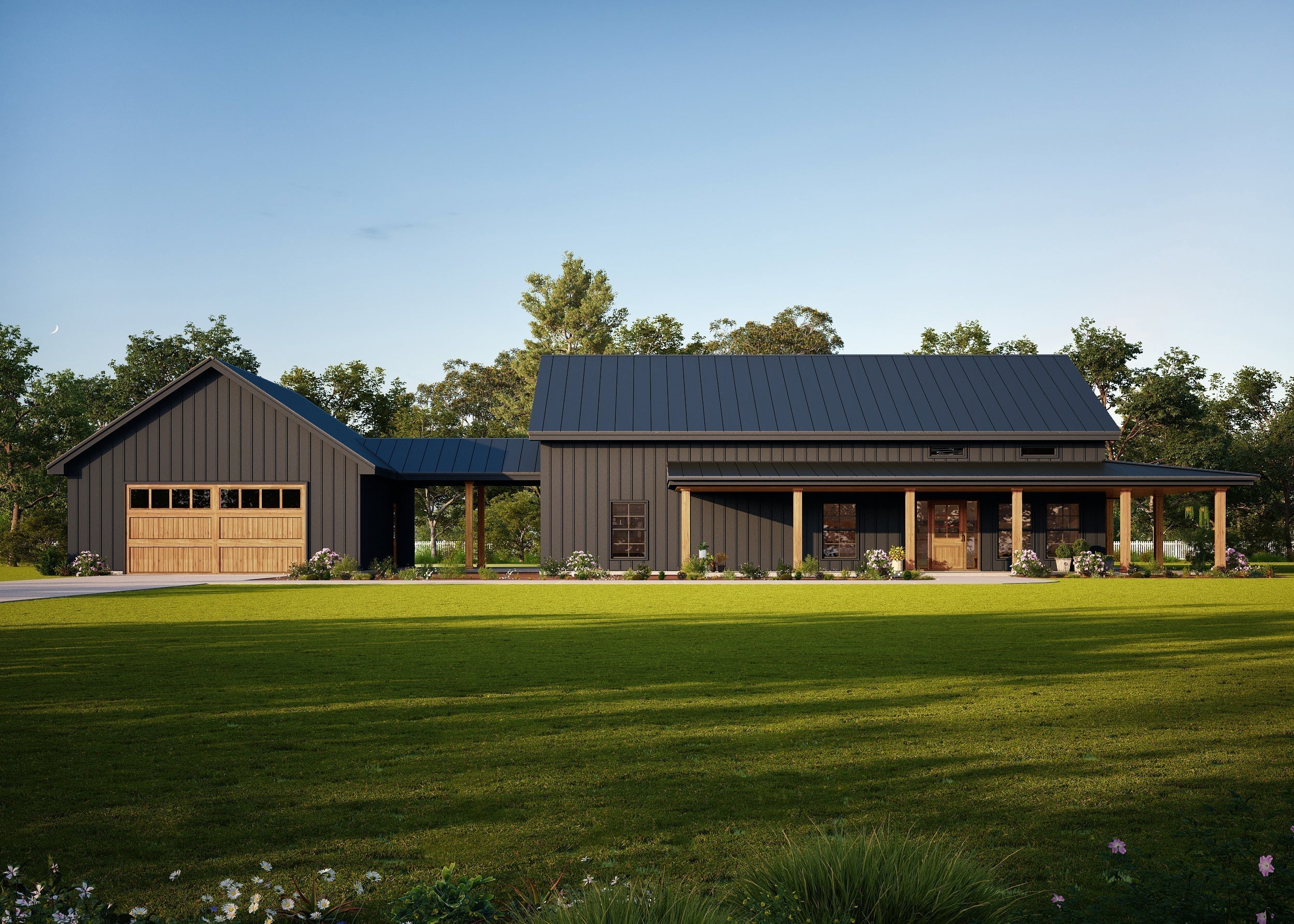
Barndominium Plans with Breezeways: Layouts, Garages & Design Tips
Barndominium plans with breezeways are one of the best layout options for homeowners who want a connected garage, shop, RV bay, guest suite, or bonus space without making the entire home feel like one oversized building. A breezeway creates a covered connection between two parts of the property while still giving the home more separation, better curb appeal, and a more custom look.
For many barndominium buyers, a breezeway is the perfect balance between convenience and breathing room. You can walk from the house to the garage without being fully exposed to rain, sun, wind, or snow, but the garage is still visually and functionally separated from the main living area.
This matters because garages and shops can be noisy, dusty, and full of vehicle fumes, tools, equipment, storage, and daily clutter. A breezeway helps separate that activity from the home while keeping everything connected in a practical way.
If you like the clean, connected look of today’s modern farmhouse layouts, browsing modern farmhouse plans can be a great way to see how covered transitions, garages, porches, and strong exterior lines can work together.
What Is a Breezeway in a Barndominium Plan?
A breezeway is a covered passage that connects two areas of a home or property. In barndominium design, it is most often used to connect the main house to a garage, shop, guest suite, RV bay, bunk room, or storage building.
A breezeway can be:
- Open-air and covered
- Partially enclosed
- Fully enclosed
- Built with glass walls
- Connected to a mudroom
- Connected to a garage or shop
- Used as a transition space between home and utility areas
The best breezeway designs do more than connect buildings. They add architectural character, improve everyday function, and make the overall layout feel more intentional.
Why Barndominium Plans with Breezeways Are So Popular
Barndominiums often include larger garages, shops, RV storage, or equipment areas. Without careful design, those spaces can overpower the home. A breezeway helps soften the transition between the main living area and the garage or shop.
Breezeways are popular because they can provide:
- Covered access from the home to the garage
- Better separation between living space and vehicle storage
- Improved curb appeal
- More architectural interest
- A natural mudroom connection
- Better noise separation
- More flexibility for future garage or shop additions
- A cleaner transition between the house, garage, and outdoor living areas
For homeowners building on land or acreage, a breezeway can make the home feel more custom and less like one large rectangular structure.
Best Barndominium Breezeway Layout Ideas
There are several ways to design a barndominium with a breezeway. The right layout depends on your land, driveway approach, garage size, shop needs, porch placement, and how much separation you want between the home and the attached or detached structure.
1. Breezeway Between the House and Garage
This is one of the most practical breezeway layouts. The main home stays visually separate from the garage, but the breezeway gives you covered access between both spaces.
This layout works well for homeowners who want:
- A 2-car or 3-car garage
- Better curb appeal
- A mudroom connection
- Separation from vehicle noise
- More flexible garage placement
A garage can dominate the front of a home if it is attached directly to the main structure. A breezeway gives you more control over the exterior elevation and helps the garage feel like part of the design instead of the main feature.
2. Glass Breezeway Barndominium
A glass breezeway can make the connection between the home and garage feel more refined. Instead of a dark hallway or simple covered walkway, the breezeway becomes a bright architectural feature.
A glass breezeway can help create:
- More natural light
- A modern farmhouse look
- A stronger indoor-outdoor feel
- A more upscale transition between buildings
- Better visual separation between the home and garage
Glass breezeways work especially well with black or white exteriors, metal roofing, large windows, board-and-batten siding, and modern farmhouse styling.
3. Breezeway with Bonus Room Over the Garage
A breezeway can also connect the main home to a garage with bonus space above. This is a smart layout for families who want extra sleeping space, a bunk room, home office, guest suite, media room, or hobby space without placing everything inside the main house.
Bonus space above the garage can work well for:
- Teen suites
- Guest rooms
- Bunk rooms
- Home offices
- Game rooms
- Studio space
- Overflow guest space where allowed
This type of layout can be especially useful on rural land, lake lots, hunting properties, family compounds, or vacation properties where guests may visit often.
4. Breezeway to a Detached Shop
Some homeowners want the shop connected but not directly attached to the main living space. A breezeway can solve that problem. It gives you covered access while still keeping workshop noise, tools, dust, fumes, and equipment away from the main house.
This layout is useful for:
- Woodworking shops
- Mechanic shops
- Farm or homestead storage
- Home business workspace
- Equipment storage
- Hobby shops
A breezeway-connected shop can make the property more functional without making the home feel like it is built inside the workshop.
5. Breezeway with Mudroom Entry
One of the most functional breezeway layouts connects directly to a mudroom. This is especially useful for families, rural homeowners, pet owners, and anyone building on land.
A breezeway-to-mudroom connection gives you a place for:
- Boots
- Coats
- Backpacks
- Tools
- Pet supplies
- Outdoor gear
- Sports equipment
- Freezer or pantry overflow
This type of layout keeps the main living space cleaner and gives the home a practical everyday entry point.
Benefits of a Breezeway Barndominium
Better Curb Appeal
Large garages can dominate a home’s front elevation. A breezeway allows the garage to sit slightly apart from the main home, which can make the exterior look more balanced, custom, and residential.
More Separation from Garage Noise
Garages and shops can be noisy. A breezeway creates a buffer between the living areas and vehicle doors, tools, compressors, equipment, or workshop activity.
Less Fume Transfer
Separating the garage from the main living space can help reduce direct transfer of vehicle fumes, fuel smells, paint odors, or shop-related smells into the home.
More Flexible Garage Placement
A breezeway gives you more freedom to place the garage where it works best for the land, driveway, views, and site layout.
Better Mudroom Function
A breezeway that leads into a mudroom creates a highly functional everyday entry. This is one of the best layout choices for rural living.
More Architectural Character
A breezeway can make a barndominium feel more custom. It breaks up the mass of the building and creates a more interesting exterior shape.
Open Breezeway vs. Enclosed Breezeway
One of the biggest decisions is whether the breezeway should be open-air, partially enclosed, or fully enclosed. Each option has advantages.
Open Breezeway
An open breezeway is covered but exposed on the sides. It is usually simpler and less expensive than a fully enclosed breezeway, and it works well in mild climates.
Open breezeways are good for:
- Covered outdoor passage
- Farmhouse-style design
- Better airflow
- Lower cost
- Simple garage connections
The downside is weather exposure. Wind, rain, snow, dust, and pollen can still move through the space.
Enclosed Breezeway
An enclosed breezeway functions more like a hallway or sunroom. It can be more comfortable in cold, windy, rainy, or snowy climates.
Enclosed breezeways are good for:
- All-weather access
- Better comfort
- More natural light if glass is used
- Additional storage potential
- A more finished residential feel
The downside is cost. An enclosed breezeway may require more framing, windows, doors, insulation, flooring, lighting, and possibly heating and cooling depending on how it is classified.
Glass Breezeway
A glass breezeway can be one of the most attractive options. It creates a bright connection between structures while keeping the home visually open and modern.
This style works especially well when the goal is to make the breezeway a design feature instead of just a walkway.
How Much Does a Breezeway Add to a Barndominium Cost?
The cost of adding a breezeway depends on size, materials, roof design, foundation, enclosure type, windows, doors, lighting, insulation, and whether it is open or fully finished.
A simple covered breezeway may cost much less than a fully enclosed glass breezeway. A breezeway with conditioned space, windows, finished flooring, insulation, drywall, and electrical will cost more because it starts to function more like finished or semi-finished space.
Cost factors include:
- Breezeway length and width
- Roof structure
- Foundation or slab
- Open vs. enclosed design
- Glass walls or windows
- Exterior doors
- Lighting and electrical
- Insulation
- Flooring
- Drainage
- Connection to garage or shop
The best way to control cost is to decide early what the breezeway is supposed to be. A simple covered connector, an enclosed hallway, a glass gallery, and a conditioned sunroom are not priced the same way.
Does a Breezeway Count as Finished Living Space?
Not always. Whether a breezeway counts as finished living space depends on how it is built, whether it is enclosed, whether it is heated and cooled, and how your local building department, appraiser, or lender classifies it.
A simple open breezeway may be counted more like covered outdoor space. A fully enclosed and conditioned breezeway may be treated differently.
This matters for:
- Pricing
- Appraisal
- Permits
- Total square footage
- Insurance
- Financing
Before finalizing the plan, ask your builder, lender, and local building department how the breezeway will be classified.
Best Rooms to Connect to a Breezeway
The breezeway should connect to practical spaces, not random rooms. The best connection point is usually a mudroom, laundry room, side entry, pantry zone, or utility area.
Good breezeway connection points include:
- Mudroom
- Laundry room
- Side entry
- Kitchen hallway
- Pantry zone
- Garage entry
- Shop entry
- Guest suite entrance
A breezeway that connects directly into the great room may look dramatic, but it can create traffic, noise, and clutter in the main living area. A mudroom connection is usually more practical.
Best Exterior Styles for Breezeway Barndominiums
Breezeways work with several barndominium styles. They are especially strong with modern farmhouse, black barndominium, rustic rural, ranch-style, and compound-style designs.
Popular exterior combinations include:
- Black barndominium with glass breezeway
- White farmhouse-style barndominium with detached garage
- Board-and-batten home with breezeway garage
- Metal-sided barndominium with shop connection
- Barndominium with wraparound porch and breezeway
- Ranch-style barndominium with side-entry garage
If you want the breezeway to feel clean, timeless, and residential, a modern farmhouse exterior is one of the easiest styles to work with. You can compare design inspiration in the modern farmhouse plans collection.
Land Considerations for a Barndominium with a Breezeway
A breezeway layout usually creates a wider overall footprint, especially when the garage sits to the side of the main home. Before choosing a plan, make sure your land can support the house, breezeway, garage, driveway, septic, well, and setbacks.
Before finalizing the layout, ask:
- Will the full width fit inside the building envelope?
- Will the garage doors face the right direction?
- Is there enough driveway space?
- Can vehicles turn around easily?
- Where will septic and well systems go?
- Does the breezeway block views or natural light?
- Will drainage work around the breezeway and garage?
- Are there HOA or deed restrictions?
A breezeway can make a home more beautiful and functional, but only if the land supports the layout. Garage placement, driveway approach, drainage, and views all need to be considered early.
Can a Breezeway Barndominium Be Built with a Kit?
Yes, many barndominium plans with breezeways can be paired with a kit or organized building package depending on the plan, engineering, builder, and local requirements.
A kit may help organize materials such as framing, roofing, siding, trim, fasteners, and sometimes windows and doors. However, the breezeway needs to be included in the design and priced correctly. It affects the roofline, slab, wall connections, exterior doors, drainage, and possibly the garage package.
A kit usually does not include:
- Land
- Foundation
- Site work
- Builder labor unless specified
- Utilities
- Permits
- Interior finish-out
- Electrical, plumbing, and HVAC
- Drywall, flooring, cabinets, and fixtures
If the breezeway is part of the design, make sure it is shown clearly in the plan and included in any pricing discussions.
Can You Add a Breezeway to an Existing Barndominium Plan?
Yes. Many stock barndominium plans can be modified to add a breezeway, detached garage, larger garage, shop, RV garage, or bonus space above the garage. The key is making those changes early before engineering, kit pricing, permitting, or construction begins.
Common breezeway modifications include:
- Adding a garage connected by breezeway
- Changing an attached garage to a breezeway garage
- Adding a glass breezeway
- Adding a shop connection
- Adding bonus space over the garage
- Changing garage door direction
- Expanding the mudroom
- Changing rooflines to connect both structures
- Adjusting porch and driveway layout
It is much easier to design the breezeway correctly at the beginning than to add it after the home has already been engineered or built.
Financing a Barndominium with a Breezeway
A breezeway barndominium can be financed, but the project should be documented clearly. Lenders may want to understand the finished living space, garage square footage, breezeway area, bonus space, total project cost, and appraised value.
Before talking to a lender, gather:
- Professional plans
- Finished living square footage
- Garage square footage
- Breezeway square footage
- Builder estimate
- Kit quote, if using a kit
- Land information
- Construction budget
- Permit research
The more clearly the breezeway, garage, and finished living areas are labeled, the easier it is for lenders, appraisers, builders, and insurance agents to understand the project.
Common Mistakes with Breezeway Barndominium Plans
Mistake 1: Making the Breezeway Too Narrow
A breezeway should feel comfortable, not like an afterthought. If it is too narrow, it may feel cramped and less useful.
Mistake 2: Forgetting About Drainage
Water needs to drain away from the home, breezeway, and garage. Poor drainage can create moisture problems and maintenance issues.
Mistake 3: Connecting the Breezeway to the Wrong Room
A mudroom or laundry entry usually works better than connecting directly into the great room or kitchen.
Mistake 4: Ignoring the Driveway
The garage and breezeway layout must work with the driveway. Make sure vehicle access, turning radius, and parking all make sense.
Mistake 5: Underestimating Cost
A breezeway still requires structure, roofing, slab work, lighting, doors, and finishes. A glass or enclosed breezeway can add more cost than expected.
Mistake 6: Not Planning the Garage Early
The garage, breezeway, and main home should be designed together. Adding them later can create expensive changes.
Is a Barndominium with a Breezeway Right for You?
A breezeway barndominium may be right for you if you want a connected garage, shop, guest suite, or bonus space without attaching it directly to the main living area.
This layout may be a good fit if:
- You want a large garage but better curb appeal
- You want separation from garage noise and fumes
- You want covered access from the home to the garage
- You need a mudroom entry
- You want a shop or garage connected but not fully attached
- You like modern farmhouse or compound-style layouts
- You are building on land with enough width for the layout
If your home needs garage space, shop space, or bonus space, a breezeway may be one of the best design choices you can make.
Final Thoughts on Barndominium Plans with Breezeways
Barndominium plans with breezeways offer a smart balance of function, comfort, and curb appeal. They connect the home to the garage, shop, guest suite, or bonus area while still creating separation between living space and utility space.
The best breezeway layouts are planned early. Think about how the breezeway connects to the mudroom, how the garage sits on the land, how the driveway approaches the doors, and whether the breezeway should be open, enclosed, or full glass.
Start with a strong floor plan, understand your land, talk to builders early, and decide whether a breezeway connection gives your barndominium the flexibility and function you need.
FAQ: Barndominium Plans with Breezeways
What is a breezeway in a barndominium?
A breezeway is a covered passage that connects the main house to another structure, such as a garage, shop, RV bay, guest suite, or bonus space.
Why add a breezeway to a barndominium?
A breezeway gives you covered access while creating separation between the home and garage or shop. It can improve curb appeal, reduce noise transfer, and create a more custom layout.
Can a breezeway connect a barndominium to a garage?
Yes. One of the most popular uses for a breezeway is connecting the main home to a 2-car, 3-car, or oversized garage.
Can a breezeway connect a barndominium to a shop?
Yes. A breezeway can connect the home to a shop while still keeping work areas separate from the main living space.
Is an open or enclosed breezeway better?
An open breezeway is usually simpler and more affordable. An enclosed or glass breezeway provides more weather protection and can feel more finished.
Does a breezeway count as living space?
Not always. It depends on whether the breezeway is enclosed, conditioned, finished, and how your local building department or appraiser classifies it.
Can I add a breezeway to a stock barndominium plan?
Yes. Many stock plans can be modified to add a breezeway, detached garage, larger garage, shop, RV bay, or bonus space. The changes should be made before engineering and pricing whenever possible.
What room should a breezeway connect to?
A mudroom, laundry room, side entry, pantry zone, or utility area usually works best. Connecting directly into the great room can create clutter and traffic problems.
Are breezeways good for modern farmhouse barndominiums?
Yes. Breezeways work very well with modern farmhouse designs because they pair naturally with covered porches, detached garages, simple rooflines, board-and-batten siding, and large windows.
Where should I start comparing styles?
A good starting point is the modern farmhouse plans collection because many of those exterior styles work well with breezeways, garage connections, and covered outdoor transitions.
```


